NutriEV in Guangzhou: Advancing Plant EV Collaboration
From Europe to China: Advancing Collaboration in Plant EV Science at the International Conference on Chinese Herbal Medicine Derived Vesicles in Guangzhou
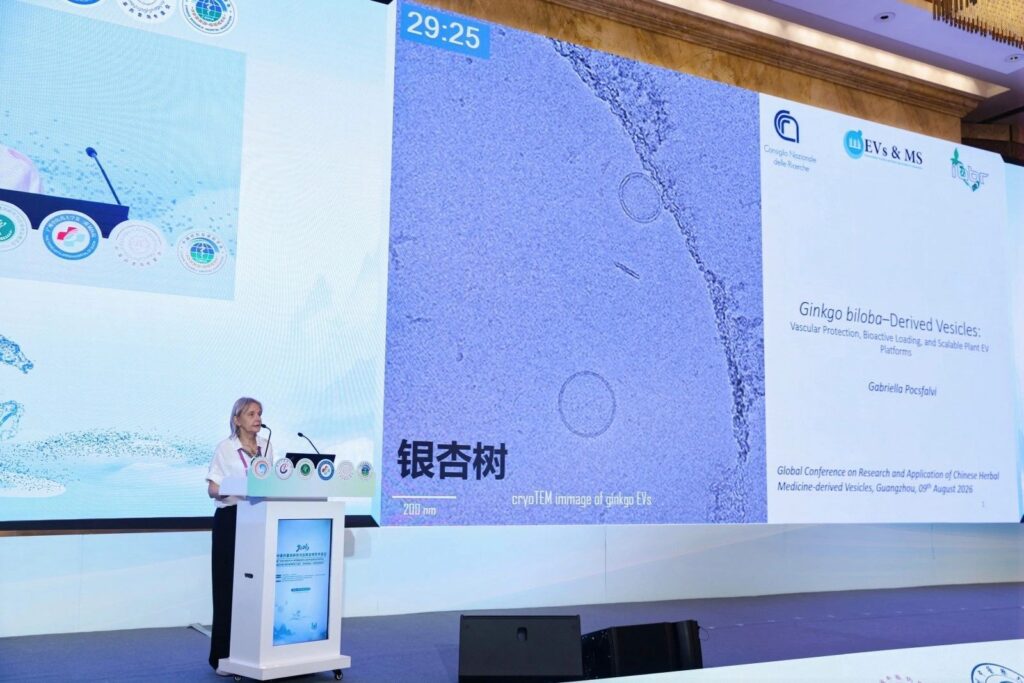
The rapidly expanding field of plant-derived extracellular vesicles (EVs) is bringing together researchers from different scientific disciplines and regions of the world. On 9 August 2026, Dr. Gabriella Pocsfalvi from the Consiglio Nazionale delle Ricerche (CNR), chair of the Plant EVs Task Force of the international Society of Extrecellular vesiclesand a partner in the NutriEV project, contributed to this international discussion with a keynote lecture at the Global Conference on Research and Application of Chinese Herbal Medicine-derived Extracellular Vesicles, held in Guangzhou, China, from 7 to 9 August. The 2026 conference focused on medicinal plant vesicles and their potential to contribute to global pharmaceutical development.
As part of her keynote, Dr.Pocsfalvi explores the emerging potential of Ginkgo biloba vesicles for vascular protection and bioactive delivery, alongside the establishment of a standardized Ginkgo cell culture platform enabling controlled EV production at scale. s. Her contribution Her contribution further emphasized the efforts of the ISEV Plant EVs Task Force in driving international collaboration, establishing community standards, reproducibility and building a vibrant and interconnected global Plant EVs network.
The event provided a valuable opportunity to connect research communities working on plant EVs and plant-derived vesicles (PDVs), particularly researchers investigating medicinal plants and traditional Chinese medicine. According to Dr. Pocsfalvi, the strong interest in medicinal plant-derived vesicles reflects the rapid development of this area and its potential applications in therapeutics, nutraceuticals and biotechnology.
This growing international interest is highly relevant to NutriEV. The project investigates EV-derived from raw and fermented plant foods, seeking to better understand their molecular composition, including their glycans, and their potential interactions with the gut, microbiome and other biological systems. NutriEV also explores whether these vesicles could support future approaches to precision nutrition and non-invasive monitoring.
The scientific discussions in Guangzhou therefore provide a broader context for NutriEV’s research. While medicinal plant vesicles and nutrition-derived vesicles are studied in different application contexts, both fields are contributing to a wider effort to understand the biological properties and potential uses of plant-derived vesicles.
Dr. Pocsfalvi’s role as Chair of the ISEV Plant EVs Task Force also brought an important community-building dimension to the event. Her participation highlighted the importance of establishing stronger connections between researchers working across different countries, plant species and application areas. In particular, discussions with colleagues researching traditional Chinese medicinal plants pointed towards opportunities to strengthen links between the global Plant EV community and researchers exploring the biodiversity of medicinal plants.
During the meeting, Dr. Pocsfalvi (IBBR-CNR) was also appointed as an Editorial Board Member of Extracellular Vesicles and Circulating Nucleic Acids. The appointment will run from August 2026 to August 2028 and reflects her continued contributions to the advancement of extracellular vesicle research and the scientific community.
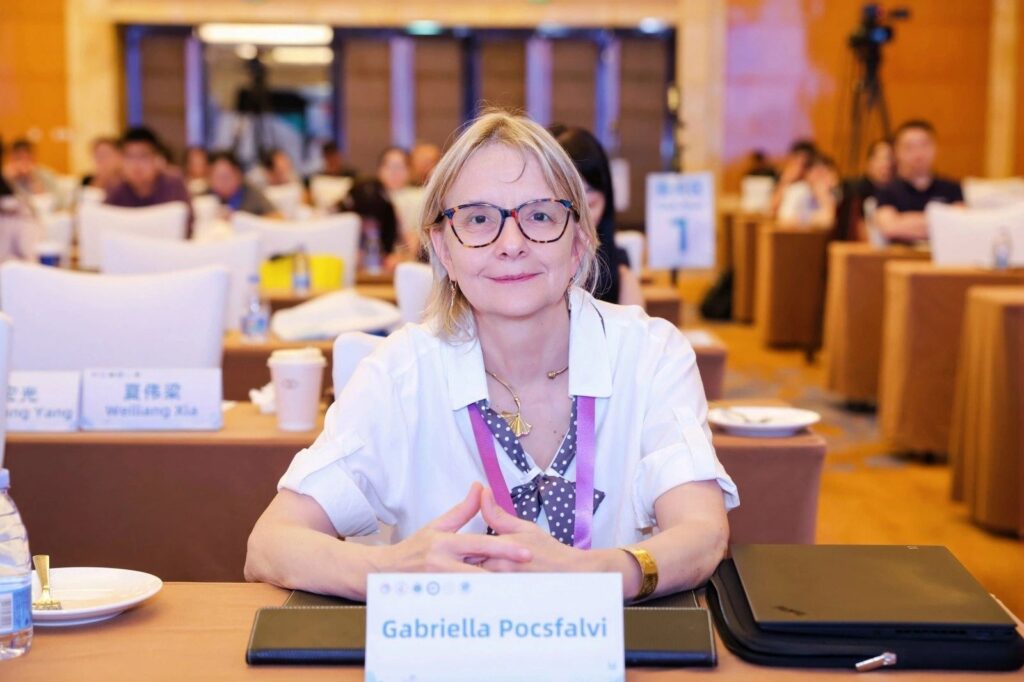
“International research on plant-derived vesicles is helping us better understand how natural nanoparticles from plants contribute to human health. This aligns perfectly with NutriEV’s goal of exploring the mechanisms behind the health benefits of plant-based foods.” Dr. Gabriella Pocsfalvi
For NutriEV project is particularly valuable as the project advances its own research on selected plant-derived vesicles. NutriEV brings together complementary expertise spanning plant EV production and characterization, fermentation, molecular and cell biology, microbiome research, organoid models, in vivo studies, and clinical research, creating a unique multidisciplinary environment for innovation in the field.
The Guangzhou conference further highlighted the increasingly interdisciplinary nature of plant extracellular vesicle research. The field is rapidly evolving beyond the fundamental characterization of vesicles towards a deeper understanding of their biological functions, translational potential, and technological applications. Discussions throughout the meeting emphasized key challenges and opportunities related to standardization, scalable production, quality control, regulatory frameworks, and the future translation of plant-derived vesicles into medical, nutraceutical, and biotechnology applications.
“I was particularly impressed by the remarkable scientific and technological progress achieved over the last decade. Equally striking was the breadth of natural resources represented by Chinese medicinal herbs, which provide an extraordinarily rich and largely unexplored source of bioactive vesicles and biomaterials. The strong integration of traditional medicinal knowledge with modern vesicle science creates unique opportunities for discovery and innovation.” Dr. Gabriella Pocsfalvi
The visit also contributed to strengthening international collaborations within the NutriEV network. Notably, Prof. Seppo Vainio, the coordinator of NutriEV, visited Guangzhou last year with similar objectives, establishing valuable connections with the local research community. Building on these interactions, my participation further reinforced the relationship between NutriEV and Prof. Zhao Kewei, Director of the Guangdong Engineering Research Center for Chinese Herbal Medicine Vesicles at Guangzhou University of Chinese Medicine, creating new opportunities for future scientific exchange and collaboration.
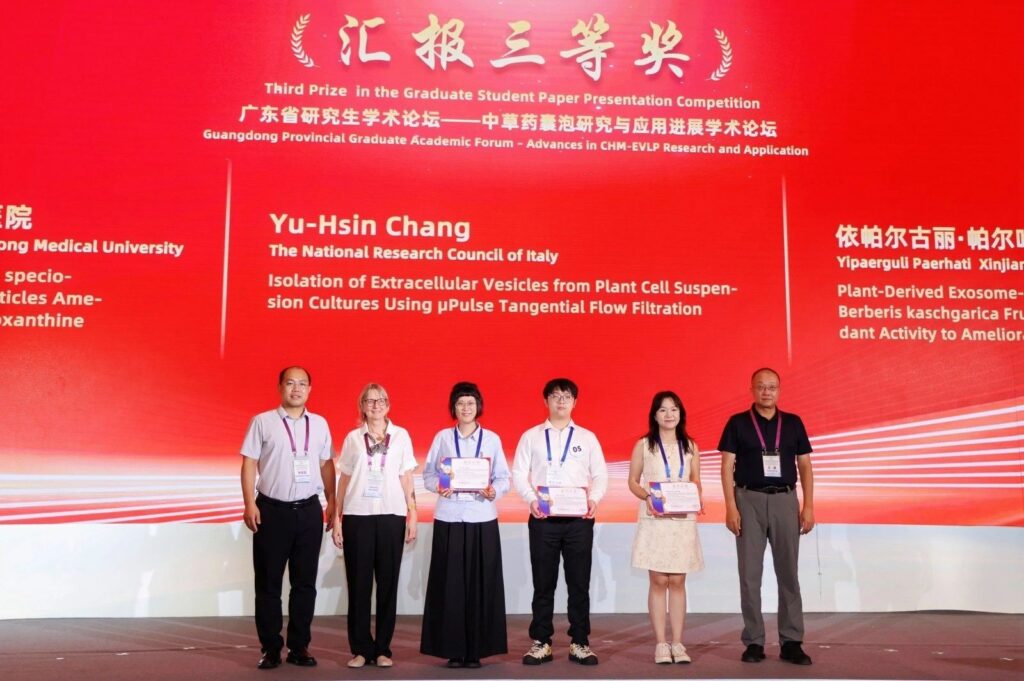
“I am also delighted to congratulate Yu-Hsin Chang (PhD student at IBBR-CNR), a young researcher from the NutriEV project, who was selected for an oral presentation in the student competition. Yu-Hsin was awarded third place for her work on the development of microPulse Tangential Flow Filtration (TFF) methods for plant EV isolation from cell suspension cultures, highlighting an innovative approach towards scalable and standardized plant EV production. Congratulations, Yu-Hsin, on this well-deserved recognition!” Dr. Gabriella Pocsfalvi